Contents:
- Pricing
- Benchmarking
- Specs
- 3D Graphical Testing
- Computational Testing
- DeepSeek-MoE-16B Performance
- Conclusion
Here at Boston, we have the fantastic opportunity to work with the latest and greatest hardware. In this article we will be looking at the NVIDIA RTX PRO 6000 Blackwell Max-Q Workstation Edition! Packing the same 96GB of GDDR7 memory, 5th-gen Tensor Cores and 4th-gen RT Cores as both the Workstation and Server Editions, it matches the raw performance of other GPUs in the lineup, all within a 300W power envelope.
Pricing
For a pricing comparison, we will check the RTX PRO 6000 Blackwell Max-Q Workstation Edition against the NVIDIA RTX PRO™ 6000 Blackwell Workstation Edition and the previous generation card NVIDIA RTX 6000 Ada to see how they match up against each other.
The pricing of the RTX PRO 6000 Blackwell Max-Q Workstation Edition, at time of writing, is ~£7644, the same as the NVIDIA RTX PRO™ 6000 Blackwell Workstation Edition.
The NVIDIA RTX 6000 Ada Generation has a price tag of ~£6604.00. Despite this being a previous generation card, it is still holding its value.
The cards in question’s cost per Kw/h at maximum load are in the table below:
| GPU | Max TDP (Watts) | Kw/h |
| RTX PRO 6000 Blackwell Max-Q | 300 | 0.3 |
| NVIDIA RTX PRO™ 6000 Blackwell Workstation Edition | 600 | 0.6 |
| NVIDIA RTX 6000 Ada Generation | 300 | 0.3 |
Overall, the NVIDIA RTX 6000 Ada Generation and the RTX PRO 6000 Blackwell Max-Q would have the same power consumption per hour, whereas the NVIDIA RTX PRO™ 6000 Blackwell Workstation Edition would be double the amount. So, the question remains: does half the power mean half the performance?
Benchmarking
We put the RTX PRO 6000 Blackwell Max-Q Workstation Edition through numerous tests. We have pitted it against the NVIDIA RTX 6000 Ada Generation, the previous generations 300W TDP GPU from NVIDIA to see what performance gains it has. We have also included the NVIDIA RTX PRO™ 6000 Blackwell Workstation Edition to see if double the TDP is double the performance.
Specs
In the below table are the specs for the RTX PRO 6000 Blackwell Max-Q Workstation Edition, the NVIDIA RTX PRO™ 6000 Blackwell Workstation Edition and the NVIDIA RTX 6000 Ada Generation:
| GPU | RTX PRO 6000 Blackwell Max-Q Workstation Edition | NVIDIA RTX PRO™ 6000 Blackwell Workstation Edition | NVIDIA RTX 6000 Ada Generation |
| GPU Architecture | NVIDIA Blackwell | NVIDIA Blackwell | Ada Lovelace |
| NVIDIA® CUDA® Cores | 24,064 | 24,064 | 18,176 |
| Tensor Cores | 5th Generation | 5th Generation | 4th Generation |
| Ray Tracing Cores | 4th Generation | 4th Generation | 3rd Generation |
| AI TOPS | 3511 AI TOPS | 4000 AI TOPS | 1457 AI TOPS |
| Single-precision Performance | 110 TFLOPS | 125 TFLOPS | 91.1 TFLOPS |
| RT Core Performance | 333 TFLOPS | 380 TFLOPS | 210.6 TFLOPS |
| GPU Memory | 96GB GDDR7 with ECC | 96GB GDDR7 with ECC | 48GB GDDR6 with ECC |
| Memory Interface | 512-bit | 512-bit | 384-bit |
| Memory Bandwidth | 1792 GB/s | 1792 GB/s | 960 GB/s |
| System Interface | PCIe 5.0 x16 | PCIe 5.0 x16 | PCIe 4.0 x16 |
| Display Connectors | 4x DisplayPort 2.1b | 4x DisplayPort 2.1b | 4x DisplayPort 1.4a |
| Max Simultaneous Displays | 4x 4096 x 2160 @ 120 Hz | 4x 4096×2160 @120?Hz | 4x 4096x2160 @120 Hz |
| 4x 5120 x 2880 @ 60 Hz | 4x 5120×2880 @60?Hz | 4 x 5120 x 2880 at 60 Hz | |
| 2x 7680 x 4320 @ 60 Hz | 2x 7680×4320 @60?Hz | 2x 7680 x 4320 @ 60Hz | |
| Video Engines | 4x NVENC 9th Gen | 4x NVENC 9th Gen | 3x NVENC 8th Gen |
| 4x NVDEC 6th Gen | 4x NVDEC 6th Gen | 3x NVDEC 7th Gen | |
| MIG Instance Types | Up to 4x 24GB | Up to 4x 24GB | N/A |
| Up to 2x 48GB | Up to 2x 48GB | N/A | |
| Up to 1x 96GB | Up to 1x 96GB | N/A | |
| Power Consumption | Total board power: 300 W | Total board power: 600 W | Total board power: 300 W |
| Power Connector | 1x PCIe CEM5 16-pin | 1x PCIe CEM5 16-pin | 1x PCIe CEM5 16-pin |
| Thermal Solution | Active | Active | Active |
| Form Factor | 4.4” x 10.5” L, dual slot, full height | 5.4″ H × 12″ L, dual-slot, extended height | 4.4” x 10.5” L, dual slot, full height |
| Graphics APIs | DirectX 12, Shader Model 6.6, OpenGL 4.63, Vulkan 1.3 |
DirectX 12, Shader Model 6.6, OpenGL 4.6, Vulkan 1.3 |
DirectX 12, Shader Model 6.6, OpenGL 4.6, Vulkan 1.3 |
| Compute APIs | CUDA 12.8, OpenCL 3.0, DirectCompute | CUDA 11.6, OpenCL 3.0, DirectCompute | CUDA 11.6, OpenCL 3.0, DirectCompute |
3D Graphical Testing
Blender 4.5.0
The Blender benchmark evaluates performance by rendering three scenes using either the CPU or GPU. Results are measured in samples per minute — a higher value indicates better hardware performance.
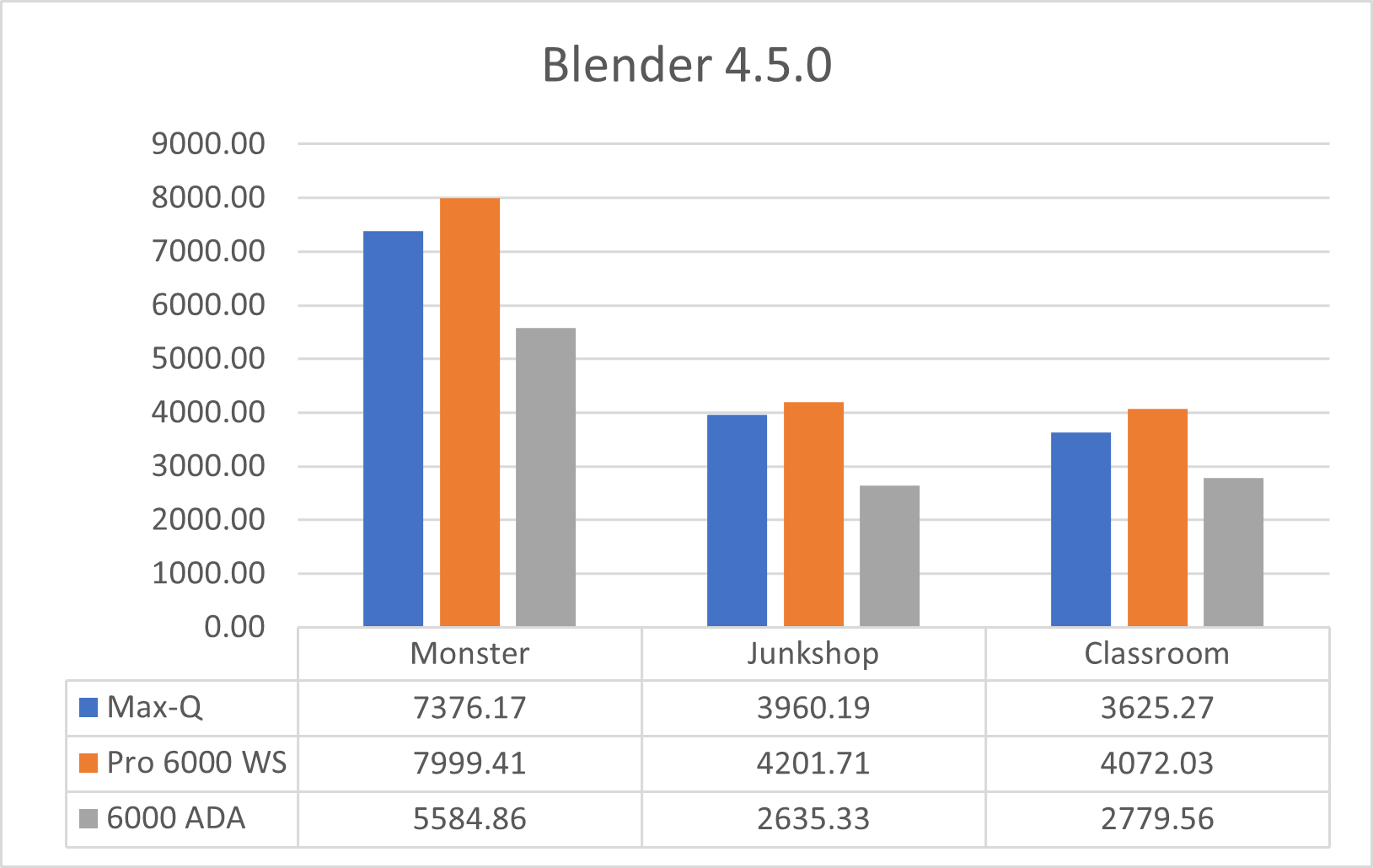
Results for Blender 4.5.0
The RTX PRO 6000 Blackwell Max-Q does beat the previous NVIDIA RTX 6000 Ada Generation across all three tests. With the Monster scene, the Max-Q had ~32% better performance overall, the Junkshop scene it saw a performance jump of ~50% and the Classroom scene shows improvement of ~30% overall.
Pitting it against the full fat variant however, the Pro 6000 WS did beat it at every turn but not by the margins you would expect. It only had an overall performance boost of ~8.5%, ~6% and ~12% respectively.
vRay 6.00.02
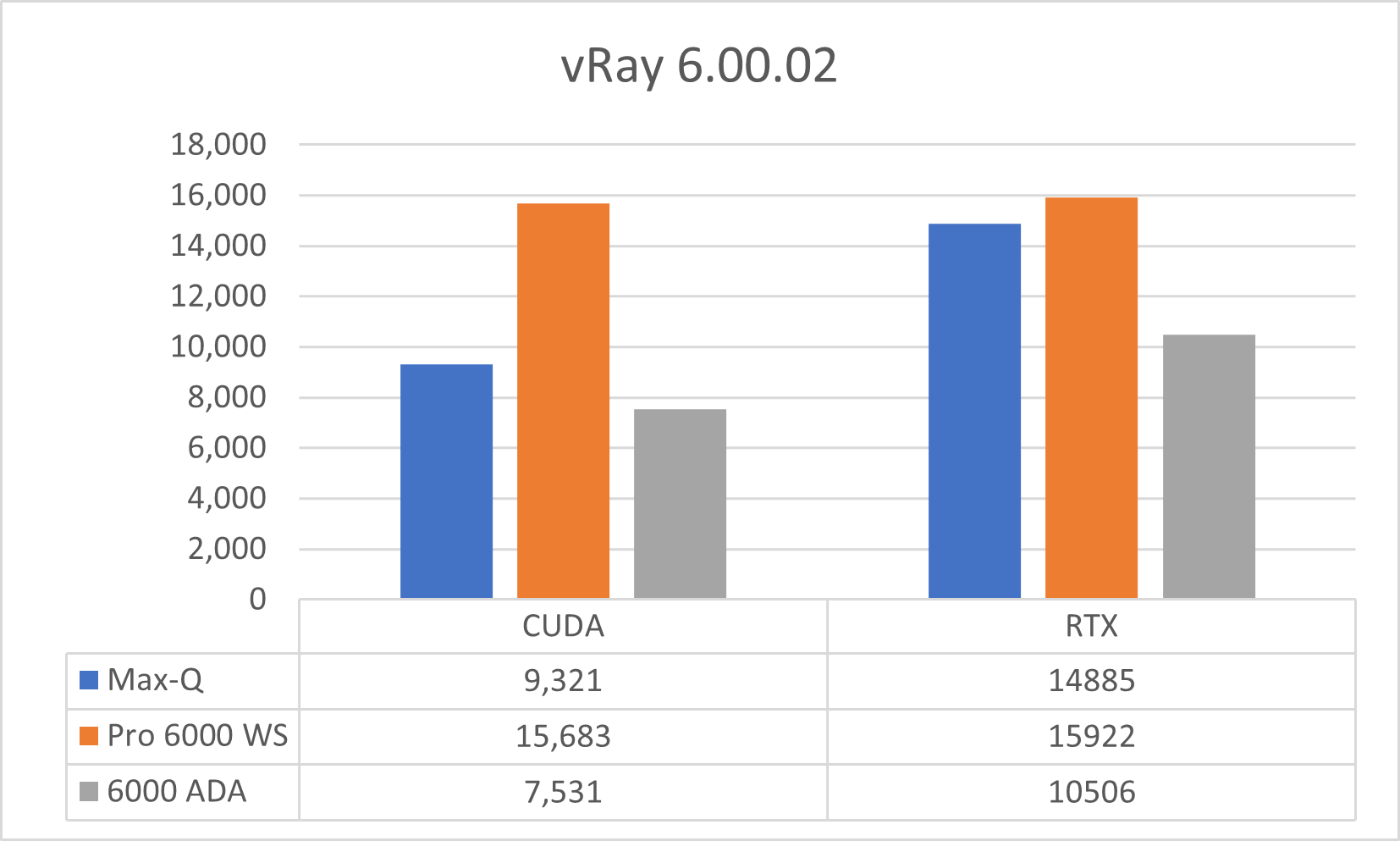
The V-Ray benchmark renders a predefined scene using either the CPU or GPU, measuring performance in samples per minute — a higher score reflects better performance. For GPU testing, you can choose between CUDA and RTX modes: CUDA leverages parallel computing, while RTX focuses on real-time ray tracing.
Results for vRay 6.00.02
Once again, the RTX PRO 6000 Blackwell Max-Q outperformed the NVIDIA RTX 6000 Ada Generation across both tests. With the parallel CUDA test, it saw an improvement of ~24%; with the real time Ray Tracing it outperformed it at the ~42% mark.
When compared to the NVIDIA RTX PRO™ 6000 Blackwell Workstation Edition, however, it was outperformed. CUDA was blown away with the Pro 6000 WS being ~68% better in performance, however, only saw a marginal improvement of ~7% with Ray Tracing.
Computational Testing
BERT Encoder Performance
| Metric | NVIDIA RTX PRO™ 6000 Blackwell Workstation Edition | RTX PRO 6000 Blackwell Max-Q Workstation Edition |
| Throughput (Sentences/sec) | 116 → 215 → 197 | 141.18 → 179.47 → 145.48 |
| Power (W) | 455 → 563 → 544 | 298.8 → 299.4 → 296.02 |
| Avg. GPU Utilization (%) | 76 → 89 → 96 (avg 85%) | 84 → 95 → 96 (avg 83%) |
| Temperature (°C) | 73 → 80 → 78 | 84.3 → 85.4 → 85.24 |
In the BERT Encoder tests, the NVIDIA RTX PRO™ 6000 Blackwell Workstation Edition delivers ~20–25% higher throughput than the Max-Q Blackwell, achieving peak speeds of 215 vs 179 sentences per second. However, this comes at a cost of roughly ~85–90% higher power consumption, resulting in the Max-Q offering nearly 2× better performance-per-watt. GPU utilisation is nearly identical, ~85% vs ~83%, but the desktop RTX PRO 6000 runs ~8–10% cooler (78C vs 85C). Overall, the NVIDIA RTX PRO™ 6000 Blackwell Workstation Edition leads in raw speed, while the RTX PRO 6000 Blackwell Max-Q Workstation Edition excels in efficiency and thermal-constrained performance.
DeepSeek-MoE-16GB Performance
| Metric | NVIDIA RTX PRO™ 6000 Blackwell Workstation Edition | RTX PRO 6000 Blackwell Max-Q Workstation Edition |
| Throughput (Sentences/sec) | 2 → 5 → 7 | 1.59 → 3.08 → 3.85 |
| Memory Used (MB) | 41 000 → 46 000 → 65 000 | 40 182 → 47 358 → 74 222 |
| Power (W) | 261 → 378 → 441 | 209.74 → 288.16 → 299.79 |
| Avg. GPU Utilisation (%) | 67 → 78 → 92 (avg 75%) | 58 → 82 → 95 (avg 78%) |
| Temperature (°C) | 55 → 67 → 63 | 84.3 → 86.74 → 87.07 |
In the DeepSeek-MoE-16B testing, the NVIDIA RTX PRO 6000 Blackwell Workstation Edition outperforms the RTX PRO 6000 Blackwell Max-Q Workstation Edition, achieving up to ~80–100% higher throughput while using slightly less memory at peak loads. The desktop GPU consumes ~45% more power at peak but maintains much cooler temperatures, averaging around ~63C compared to the RTX PRO 6000 Blackwell Max-Q Workstation Editions 87C. GPU utilisation is slightly lower on the NVIDIA RTX PRO 6000 Blackwell Workstation Edition (avg 75% vs 78%), reflecting efficient scaling under heavier workloads. Overall, the NVIDIA RTX PRO 6000 Blackwell Workstation Edition offers superior performance and thermal stability, while the RTX PRO 6000 Blackwell Max-Q Workstation Edition prioritises energy efficiency despite higher operating temperatures.
Overall Comparison
| Aspect | NVIDIA RTX PRO™ 6000 Blackwell Workstation Edition | RTX PRO 6000 Blackwell Max-Q Workstation Edition |
| Peak BF16 TFLOPS | 396 – 405 | 263.6 – 282.2 |
| Peak FP8 TFLOPS | 500 – 600 | 419.1 – 519.2 |
| Performance | Higher raw throughput | Slightly lower, very consistent |
| Efficiency | Moderate | Excellent (~2× perf/W) |
| Thermals | Stable (≤ 80 °C) | High (≈ 85 °C) |
| Best Use | Workstation / server | Mobile / low-power systems |
The NVIDIA RTX PRO™ 6000 Blackwell Workstation Edition delivers ~45–50% higher BF16 and 10–20% higher FP8 compute performance than the RTX PRO 6000 Blackwell Max-Q Workstation Edition, providing greater raw throughput suited for workstation and server environments. However, the RTX PRO 6000 Blackwell Max-Q Workstation Edition variant offers roughly twice the performance per watt, making it far more power-efficient. Thermally, the NVIDIA RTX PRO™ 6000 Blackwell Workstation Edition operates cooler and more stable at ≤ 80 °C, while the Max-Q runs hotter at around 85 °C due to its compact, low-power design. In summary, the NVIDIA RTX PRO™ 6000 Blackwell Workstation Edition prioritises maximum performance, while the RTX PRO 6000 Blackwell Max-Q Workstation Edition version focuses on efficiency and mobility.
Conclusion
The RTX PRO 6000 Blackwell Max-Q Workstation Edition showcases NVIDIA’s biggest leap in efficiency and performance to date, offering nearly 2× better performance-per-watt while matching much of the full-power model’s capability. It delivers impressive real-world results, outperforming the previous RTX 6000 Ada Generation by ~30–50% across Blender 4.5.0 scenes and achieving gains of ~24% in CUDA and ~42% in real-time ray tracing. When compared to the NVIDIA RTX PRO™ 6000 Blackwell Workstation Edition, it trails by only ~8–12% in most tests despite drawing roughly 45% less power, making it ideal for mobile, edge and thermally constrained systems. Notably, the Max-Q is designed to scale across multiple cards, making it ideal for distributed or parallel workloads where efficiency and combined performance matter more than individual GPU power. Though both of the Pro 6000 GPUs are priced at ~£7,859.99, the RTX PRO 6000 Blackwell Max-Q Workstation Edition offers superior energy efficiency, compact performance and excellent scalability, representing the most balanced choice for professionals seeking cutting-edge Blackwell power in a more efficient and versatile form factor.
Boston is dedicated to helping our customers make informed decisions when choosing the right hardware, software and complete solutions tailored to their unique requirements and test drives of the RTX PRO 6000 Blackwell Max-Q Workstation Edition are already available via our onsite R&D and test facility. The team are ready to enable customers to test-drive the latest technology on-premises or remotely via our fast internet connectivity.
If you are ready to start your workstation journey, then please get in touch either by emailing us at sales@boston.co.uk or by calling us on 01727 876100 and one of our experienced sales engineers will happily guide you to your perfect tailored solution and invite you for a demo.
Author
Peter Wilsher
Field Application Engineer
Boston Limited